
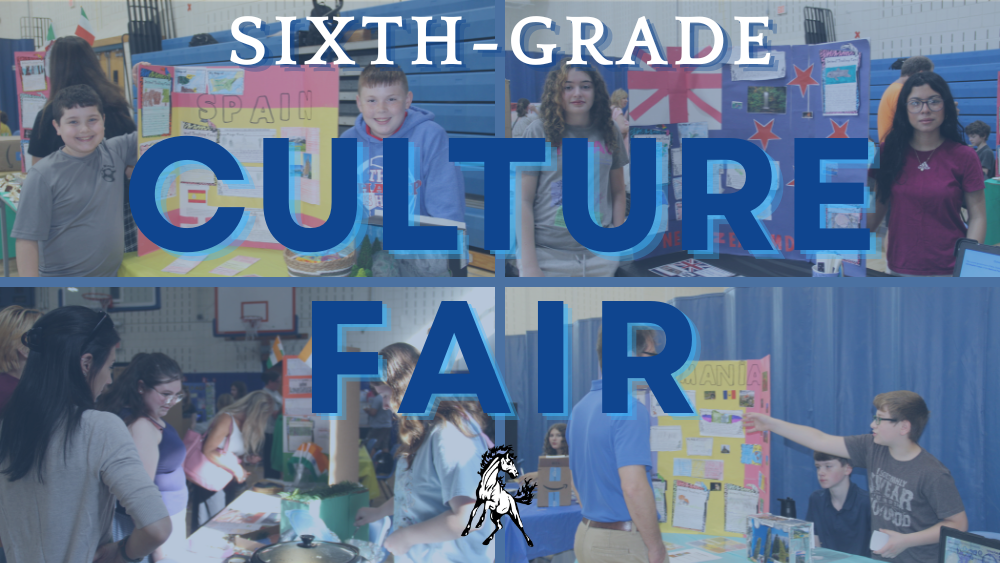
The Annual Sixth-Grade Culture Fair took place May 19, 2026.
All sixth-grade students are assigned a country to research and present. Unless students have a direct connection to a specific country, they are assigned a country from the Eastern Hemisphere through a random drawing. In addition to creating a tri-fold poster board, students create a PowerPoint presentation, a diorama, and a dish that represents the cuisine of their assigned country. More than 30 countries were represented at this year's fair.
In addition to participation from the entire sixth grade, high school members of the Interact Club also created presentations for this year’s fair.
The annual event has been organized by social studies teacher Susan Bright for the past 20 years.
When asked what she hopes students take away from the project, Bright said the intention of the fair has evolved over the years.
“Originally, it was just an opportunity for students to learn about countries in the Eastern Hemisphere and practice group work. Now it has really blossomed into something more. I want students to understand perspective, accept diversity, and learn about different cultures. I’ve had some of my students telling me about places they want to travel to. I’d like to see more of them want to explore these places. During the process of working on these projects, I see them developing skills that are useful for careers related to graphic design, gastronomy, tourism, history, science, and geology.”
Although the fair has since become a longstanding Cairo-Durham tradition, it had humble beginnings.
Former Cairo-Durham sixth-grade teachers Kerry Overbaugh and Simon Williams first started a small project in 1998 with a couple of sixth-grade classes. That project became the foundation of today’s culture fair. Afterward, Diane Zduniak expanded and continued the tradition. Bright later took the lead and helped make the event what it is today.
Overbaugh explained how the project started.
“In 1998, the sixth grade was made up of teams and there were 165 students. There were two houses and everything was done cross-curricular. So if we were doing a unit on Egypt, I would be teaching about the history of Egypt, Mrs. Howell would be reading The Egypt Game, and Mr. LeTart would be designing the Hanging Gardens of Babylon. And the same thing would happen with the other house. Then we decided, we’re doing all of this work, so wouldn’t it be cool to have the kids present it to their families? That’s when we started doing the food too. And then it just started growing.”
When asked whether she expected the culture fair to become what it is today, Overbaugh said:
“No, we never expected it. We first started it because it was a way to showcase students’ work. When I walk in there now, it’s so organized!”
One aspect of the culture fair that continues to stand out is the food.
“When it first started, there was food, but not to the extent we see now,” Overbaugh said. “Back then, there were only two or three students who would bring food.”
“It’s funny because when I walked in, it was half a gym but when we had 165 kids it was the whole gym,” Overbaugh added.
More than an academic project, the Sixth-Grade Culture Fair provides students with opportunities to develop valuable skills while inspiring them to become lifelong global learners. Nearly three-decades after it began, the fair is a testament to the dedication of Overbaugh, Williams, Zduniak, Bright and countless sixth-grade teachers who have made the tradition so successful.